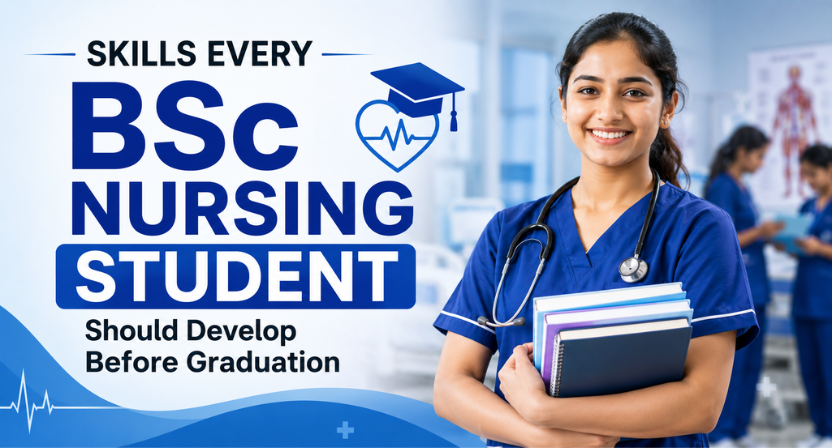
Many students believe that completing a BSc Nursing degree automatically prepares them for a successful nursing career. While academic knowledge is undoubtedly important, modern healthcare employers expect much more from nursing graduates than good examination scores.
Today’s hospitals are looking for professionals who can think critically, communicate effectively, adapt to changing situations, and provide compassionate patient care. A nurse’s role extends far beyond administering medications or following treatment instructions. Nurses are often the healthcare professionals who spend the most time with patients, making their skills and judgment crucial to treatment outcomes.
This means that the transition from being a nursing student to becoming a competent healthcare professional depends not only on what you learn in classrooms but also on the practical, interpersonal, and professional skills you develop before graduation.
Students who focus on building these skills during their BSc Nursing program often find themselves more confident during clinical postings, more prepared for interviews, and better equipped to handle real healthcare environments.
In this guide, we will explore the essential skills every BSc Nursing student should develop before graduation and why these skills matter for long-term career success.
Healthcare has changed significantly over the last decade.
Patients today are more informed. Hospitals are more technology-driven. Treatment protocols are becoming increasingly complex. At the same time, healthcare teams are expected to work together more efficiently than ever before.
In this environment, nursing is no longer viewed as a purely supportive role. Nurses are active participants in patient care planning, monitoring, recovery management, and healthcare coordination.
A nurse may be responsible for:
Because of these responsibilities, employers increasingly seek graduates who possess both technical competence and professional skills.
A nursing degree provides the foundation. Skills determine how effectively that knowledge can be applied in real-world situations.
Clinical competence remains the most important skill area for any nursing student.
Hospitals expect newly graduated nurses to understand basic clinical procedures and patient-care responsibilities. While employers know that fresh graduates will continue learning on the job, they also expect graduates to possess a strong clinical foundation.
Students should focus on developing confidence in:
Clinical competence develops through repetition and exposure.
Every clinical posting should be treated as an opportunity to improve practical skills rather than simply fulfill academic requirements.
Students who actively participate during hospital training often graduate with significantly greater confidence than those who remain passive observers.
Modern nursing requires much more than following instructions.
Nurses must constantly observe, assess, and respond to changing patient conditions.
Critical thinking involves:
Consider a patient whose blood pressure suddenly drops. A nurse must recognize that the situation may require urgent attention and communicate appropriately with the healthcare team.
The ability to think critically helps nurses identify issues early and contribute meaningfully to patient care.
Students can develop critical thinking by:
Nursing environments can be extremely demanding.
A single nurse may be responsible for multiple patients, each with different needs, medications, procedures, and documentation requirements.
Without strong organizational skills, it becomes difficult to provide efficient patient care.
Effective time management helps nurses:
Students should begin practicing organizational skills during clinical training by planning daily activities, maintaining schedules, and learning to prioritize responsibilities.
These habits become increasingly valuable in professional healthcare settings.
Emotional Intelligence and Empathy
Technical knowledge is important, but patients often remember how healthcare professionals made them feel.
Emotional intelligence refers to the ability to understand, manage, and respond appropriately to emotions—both your own and those of others.
Nurses frequently care for patients who are:
Empathy allows nurses to connect with patients on a human level while still maintaining professional boundaries.
Patients often feel more comfortable, cooperative, and confident when they believe their concerns are genuinely understood.
Developing empathy improves:
This skill is often what separates a technically competent nurse from an exceptional one.
Healthcare is a team effort.
Modern hospitals rely on collaboration between:
Nurses frequently act as the bridge connecting different members of the healthcare team.
Effective teamwork helps:
Students should learn how to work respectfully with professionals from different healthcare disciplines.
Strong collaboration skills make nurses more effective and valuable within healthcare organizations.
Healthcare is becoming increasingly digital.
Many hospitals now use:
Nurses who are comfortable with technology often adapt more quickly to modern healthcare environments.
Students should develop familiarity with:
Technology is expected to play an even larger role in nursing over the coming years.
Adaptability and Lifelong Learning
Healthcare is constantly evolving.
New treatments, technologies, guidelines, and patient-care approaches emerge regularly.
Successful nurses understand that graduation is not the end of learning—it is only the beginning.
Adaptability helps nurses:
Students who develop a mindset of continuous learning often experience stronger long-term career growth.
Professionalism and Ethical Practice
Professional behavior is essential in nursing.
Patients place enormous trust in healthcare professionals. Nurses are expected to uphold high standards of:
Professionalism influences how patients, colleagues, and employers perceive a nurse.
Students should develop professional habits early, including:
These qualities often influence career advancement just as much as clinical ability.on theatre technology professionals continues growing.
Chronic kidney disease has become a major healthcare challenge worldwide.
Many patients require dialysis treatment to manage kidney failure.
Dialysis technologists assist with:
As kidney disease prevalence increases, dialysis services continue expanding across healthcare systems.
This has created strong demand for skilled dialysis professionals.
Leadership is not limited to managerial positions.
Even newly graduated nurses are expected to demonstrate initiative, responsibility, and accountability.
Leadership skills help nurses:
Students can develop leadership by:
Leadership becomes increasingly important as nurses progress into senior roles.
Many students underestimate the value of practical exposure.
However, hospitals consistently report that graduates who have strong clinical experience often adapt more successfully to professional practice.
Clinical training helps students:
The more exposure students receive before graduation, the smoother their transition into employment is likely to be.
At Little Flower Group of Institutions, nursing education extends beyond classroom learning.
The focus is on helping students develop the practical, professional, and interpersonal skills required in modern healthcare environments.
Students benefit from:
The institution follows nursing education standards aligned with:
The goal is to prepare students not only to pass examinations but also to become competent and confident healthcare professionals.
A BSc Nursing degree provides the academic foundation for a successful healthcare career. However, professional success depends on much more than classroom performance.
Students who develop clinical competence, communication abilities, critical thinking, emotional intelligence, teamwork, professionalism, and adaptability before graduation are often better prepared for the realities of modern nursing practice.
Healthcare employers increasingly seek nurses who can combine technical knowledge with practical confidence and compassionate patient care. By investing in skill development throughout your nursing education, you can position yourself for stronger employability, greater professional growth, and long-term career success.
Clinical competence is essential, but communication, critical thinking, and professionalism are equally important for long-term success.
Nurses interact with patients, families, and healthcare teams continuously. Effective communication improves patient safety and care quality.
Active participation during clinical postings, hospital training, patient interactions, and practical learning opportunities helps build confidence.
Yes. Modern hospitals increasingly use electronic records, digital monitoring systems, and healthcare software platforms.
Emotional intelligence helps nurses understand patient concerns, build trust, and provide compassionate care.
Yes. Leadership skills improve teamwork, accountability, problem-solving, and future career advancement opportunities.