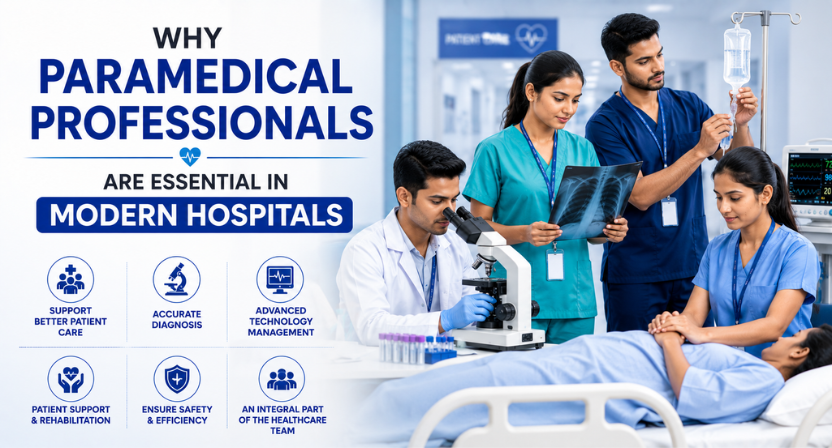
When people think about hospitals, they usually think about doctors and nurses.
While doctors diagnose illnesses and nurses provide continuous patient care, there is another group of healthcare professionals working behind the scenes who are equally important to patient outcomes.
These professionals are known as paramedical professionals.
Every day, hospitals depend on paramedical teams to perform critical functions such as:
Without these professionals, modern healthcare systems would struggle to provide accurate diagnoses, timely treatment, and effective patient care.
In fact, many healthcare experts describe paramedical professionals as the backbone of hospital operations because they support almost every stage of the patient-care journey.
As healthcare becomes more technology-driven and patient-centred, the importance of paramedical professionals continues to increase.
This is one of the reasons why paramedical education has become one of the fastest-growing healthcare career pathways for students after 12th.
1. INC and RGUHS Approval — Non-Negotiable
Paramedical professionals are trained healthcare workers who assist doctors, nurses, and healthcare teams in diagnosing, treating, and managing patients.
They possess specialized skills in areas such as:
Unlike general healthcare support staff, paramedical professionals receive formal education and clinical training that prepares them for highly specialized healthcare roles.
Their responsibilities often require technical expertise, precision, and the ability to work effectively in high-pressure healthcare environments.
These professionals form a vital link between medical diagnosis and patient treatment.
Healthcare today is far more complex than it was a few decades ago.
Modern hospitals depend on advanced technologies, specialized procedures, and multidisciplinary healthcare teams.
Doctors rarely make treatment decisions based solely on physical examinations. They rely heavily on information provided by diagnostic tests, imaging procedures, monitoring systems, and specialized healthcare services.
Many of these services are managed by paramedical professionals.
Consider a patient arriving at the emergency department with chest pain.
Before treatment begins, healthcare teams may require:
These services are often performed or supported by trained paramedical professionals.
Without timely diagnostic information, treatment decisions become significantly more difficult.
This demonstrates why paramedical professionals are not simply support staff—they are essential contributors to patient care.
Accurate diagnosis is the foundation of effective treatment.
Before doctors prescribe medications or recommend procedures, they need reliable information about a patient’s condition.
Paramedical professionals help generate this information through diagnostic services.
Medical Laboratory Technology
Medical laboratory professionals analyse:
These tests help identify:
A significant percentage of medical decisions depend on laboratory results.
Without laboratory professionals, many diseases would be difficult to diagnose accurately.
Radiology and imaging professionals help doctors visualize internal structures of the body.
They assist with:
These imaging techniques help diagnose:
Accurate imaging allows healthcare teams to make informed treatment decisions.
7. Transparency on Fees and the Admission Process
Nursing admissions in Karnataka for government and aided colleges are governed by the KEA (Karnataka Examinations Authority) counselling process. For private unaided colleges, fees are set by the Fee Regulatory Committee. Any college that asks you to pay fees significantly above the committee-approved amounts, or that pressures you to make payments before documentation is complete, should be approached with caution.
Always ask for:
Legitimate colleges are transparent about fees. If you feel pressured or if information is being withheld, that is itself a signal.
Emergency departments are among the busiest areas in hospitals.
Patients arriving in emergency situations often require immediate attention and rapid assessment.
Paramedical professionals play critical roles during:
They assist healthcare teams by:
Their ability to work quickly and accurately can directly influence patient outcomes.
Surgical procedures require highly coordinated teamwork.
Operation theatre technologists help ensure that surgical environments remain safe, organized, and efficient.
Their responsibilities include:
Every successful surgery depends on effective teamwork, and operation theatre professionals are a vital part of that process.
As hospitals perform increasing numbers of surgical procedures, demand for operation theatre technology professionals continues growing.
Chronic kidney disease has become a major healthcare challenge worldwide.
Many patients require dialysis treatment to manage kidney failure.
Dialysis technologists assist with:
As kidney disease prevalence increases, dialysis services continue expanding across healthcare systems.
This has created strong demand for skilled dialysis professionals.
Recovery does not end when a patient leaves surgery or completes treatment.
Many patients require rehabilitation to regain independence and improve quality of life.
Allied health professionals contribute through:
These services help patients recover after:
As healthcare increasingly focuses on patient outcomes, rehabilitation professionals are becoming more valuable than ever.
Healthcare technology is evolving rapidly.
Modern hospitals use:
These technologies require trained professionals who understand both healthcare and technical operations.
As hospitals adopt more sophisticated technologies, demand for qualified paramedical professionals continues growing. Students entering paramedical fields today will likely work with healthcare technologies that were not widely available just a decade ago.
One of the biggest advantages of paramedical education is the wide range of career opportunities available after graduation.
Students can pursue careers in:
Some professionals also pursue higher education and specialization opportunities within allied health sciences.
This diversity makes paramedical education an attractive option for students seeking healthcare careers.
Many students want to work in healthcare but may not wish to pursue traditional pathways such as medicine or nursing.
Paramedical courses offer an alternative pathway into healthcare while still allowing students to make meaningful contributions to patient care.
Students are increasingly choosing paramedical education because it offers:
For students interested in science and healthcare, paramedical education provides a direct route into specialized healthcare professions.
Skills That Make Successful Paramedical Professionals
Modern healthcare employers look for more than technical qualifications.
Successful paramedical professionals often possess:
Technical Competence
The ability to perform procedures accurately and safely is essential.
Attention to Detail
Small errors can significantly impact patient care and diagnostic accuracy.
Communication Skills
Professionals must communicate effectively with healthcare teams and patients.
Problem-Solving Ability
Healthcare environments frequently require quick thinking and sound judgment.
Adaptability
Healthcare technologies and treatment protocols continue evolving.
Professionals who embrace continuous learning often achieve stronger long-term career growth.
Healthcare is a practical profession.
Students cannot develop clinical confidence through classroom learning alone.
Practical exposure allows students to:
Hospitals increasingly prefer graduates who have strong practical training and clinical exposure.
This makes the quality of educational institutions particularly important.
At Little Flower Group of Institutions, paramedical education focuses on preparing students for real healthcare environments.
Students benefit from:
The institution emphasizes both academic learning and practical competence, helping students develop the skills required by modern healthcare employers.
Healthcare demand continues increasing due to:
As hospitals become more specialized and technology-driven, the need for skilled paramedical professionals is expected to grow even further.
Students entering paramedical fields today are joining professions that will remain essential to healthcare systems for decades to come.
Modern hospitals depend on much more than doctors and nurses. Paramedical professionals play critical roles in diagnosis, emergency care, surgical support, rehabilitation, and patient management. Without their expertise, healthcare systems would struggle to provide accurate diagnoses, timely treatment, and effective patient care. For students interested in healthcare careers, paramedical sciences offer an opportunity to work in meaningful, technology-driven, and highly respected professions. As healthcare continues evolving, paramedical professionals will remain among the most important contributors to patient outcomes and healthcare excellence.
Paramedical professionals are trained healthcare workers who support diagnosis, treatment, emergency care, rehabilitation, and patient management.
Yes. Hospitals rely heavily on paramedical teams for laboratory testing, imaging, emergency support, operation theatre assistance, and many other services.
Students can work in hospitals, laboratories, diagnostic centres, rehabilitation facilities, emergency care departments, and healthcare organizations.
Yes. Growing healthcare infrastructure and technological advancements continue increasing demand for qualified paramedical professionals.
Practical exposure helps students develop technical competence, clinical confidence, and real-world healthcare experience.
Yes. Paramedical sciences offer strong healthcare relevance, practical learning opportunities, and growing employment prospects.