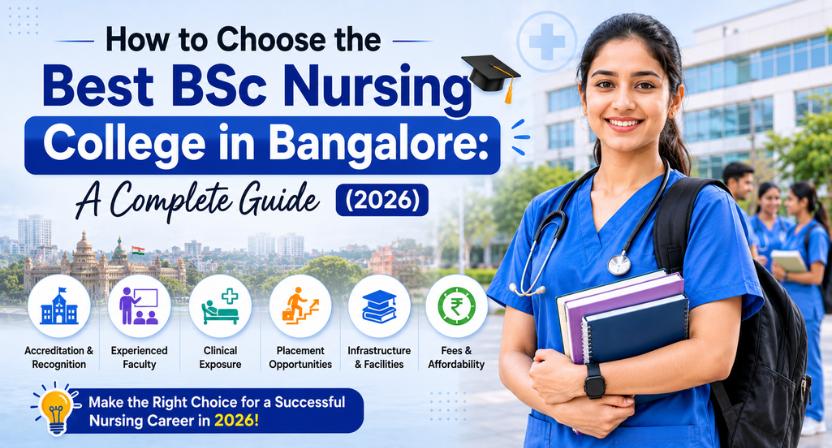
If you’ve just cleared your Class 12 with PCB and you’re searching for a BSc Nursing college in Bangalore, you probably have a simple question: How do I know which college is actually worth joining? The honest answer is this — not all nursing colleges are equal, and the difference between a good choice and a poor one will shape your career for the next 30+ years. This guide gives you a practical framework to evaluate any college, not just take brochure claims at face value.
Bangalore is home to some of India’s most reputed hospitals — Manipal Hospitals, Narayana Health, St. John’s Medical College Hospital, and several government institutions affiliated with Rajiv Gandhi University of Health Sciences (RGUHS). This density of clinical infrastructure means nursing students in Bangalore have access to real patient exposure across specialties — general medicine, surgery, paediatrics, ICU, OBG, and community health — which is simply not possible in smaller cities.
For a B.Sc Nursing student, clinical training is not supplementary — it is the qualification. The Indian Nursing Council (INC), which regulates nursing education nationally, mandates a minimum number of clinical hours per semester. A college in Bangalore that is affiliated to RGUHS and has hospital tie-ups with 200+ bed hospitals gives you a fundamentally different foundation than one that doesn’t.
But Bangalore also has a large number of nursing colleges — some excellent, some that exist primarily to collect fees. Knowing what to look for protects you.
1. INC and RGUHS Approval — Non-Negotiable
Every legitimate BSc Nursing programme in Karnataka must be:
Before you even visit a college, verify its approval status directly on the INC official website and the RGUHS. Do not rely on what the college tells you. If a college’s name does not appear in the INC-approved list, your degree will have no legal standing, and you will not be eligible to register as a nurse with the Karnataka Nurses and Midwives Council (KNC) — which means you cannot work as a nurse in Karnataka.
This is the single most important check. Everything else is secondary.
2. The Quality and Size of the Attached Hospital
The INC requires a nursing college to have access to a hospital with a minimum of 300 beds for conducting B.Sc Nursing clinical training. But bed count alone is not enough. Ask:
A nursing student learns by doing — taking vitals, administering medications under supervision, assisting in procedures, and building clinical judgment. If the hospital is underutilised or the student-to-patient ratio is too high, clinical education suffers regardless of how good the classroom instruction is.
3. Faculty Qualifications and Stability
Under INC norms, B.Sc Nursing faculty are required to hold a minimum MSc Nursing qualification in their respective specialties. More importantly, ask:
You can often gauge faculty quality by requesting to speak with a faculty member during your college visit — not just with the admissions officer. Ask them about curriculum delivery, how they handle student assessment, and how they stay current with practice. A faculty member who engages substantively with your question is a good sign.
4. NAAC Accreditation and Institutional Track Record
While INC approval is mandatory, NAAC (National Assessment and Accreditation Council) accreditation is a broader quality signal. A NAAC-accredited institution has undergone peer review of its teaching practices, infrastructure, research output, and governance. It does not guarantee everything, but it does indicate a college that takes quality audits seriously.
Additionally, look at:
5. Infrastructure That Supports Learning
Walk through the college, not just the reception area. Specifically check:
6. Placement Support and Post-Graduate Pathways
Nursing in India is in a significant demand-supply gap. According to the Ministry of Health & Family Welfare, India requires approximately 2.4 million additional nurses to meet the WHO’s recommended nurse-to-population ratio. Despite this, placement outcomes vary widely by college.
Ask the admissions office:
BSc Nursing is also a gateway to MSc Nursing, nursing specialisation, and eventually nurse practitioner or educator roles. Does the college support students who want to pursue higher studies? Is there internal guidance on RGUHS post-graduate admissions?
7. Transparency on Fees and the Admission Process
Nursing admissions in Karnataka for government and aided colleges are governed by the KEA (Karnataka Examinations Authority) counselling process. For private unaided colleges, fees are set by the Fee Regulatory Committee. Any college that asks you to pay fees significantly above the committee-approved amounts, or that pressures you to make payments before documentation is complete, should be approached with caution.
Always ask for:
Legitimate colleges are transparent about fees. If you feel pressured or if information is being withheld, that is itself a signal.
When you go for a college visit, bring this checklist:
A college that is genuinely confident in its quality will welcome scrutiny. One that deflects or makes it difficult to verify information independently should make you cautious.
Among the colleges worth evaluating in Bangalore is Little Flower Group of Institutions, a healthcare education institution offering nursing, pharmacy, physiotherapy, and allied health programmes. The institution holds INC approval and RGUHS affiliation for its BSc Nursing programme, with clinical training conducted at its attached hospital.
Little Flower’s nursing programme is also recognised by the Karnataka Nursing Council (KNC), which is required for graduate registration in the state. Faculty hold MSc Nursing qualifications across specialties including Obstetrics, Medical-Surgical Nursing, Paediatric Nursing, and Community Health Nursing.
If you are evaluating Little Flower, we encourage you to apply the same checklist above – visit the skills lab, speak with current students, and request documentation of exam results and placements.
Choosing based on proximity alone. Location matters for day scholars, but a slightly farther college with better clinical infrastructure is worth it. You will spend 4 years there.
Trusting brochure rankings. India does not have a nationally standardised nursing college ranking system. Any ranking in a brochure is self-declared unless it cites NAAC grade or NIRF score.
Not asking about the hospital. Many students tour the college building and never visit the attached hospital. The hospital is where your education actually happens.
Ignoring the fee structure fine print. Understand the total cost — tuition, clinical, hostel, exam, and miscellaneous fees – across all 4 years. Calculate what you can manage, and explore Karnataka government scholarships for nursing students.
Deciding under time pressure. Admissions cycles can feel urgent, but a week of additional due diligence is worth it. The right college changes your career trajectory.
Choosing the best BSc Nursing college in Bangalore requires more than comparing fees or location. Focus on key factors such as INC approval, RGUHS affiliation, clinical training opportunities, faculty expertise, infrastructure, and placement support. Taking the time to evaluate these aspects can help you make an informed decision and build a strong foundation for a successful nursing career. With the right college, you can gain the knowledge, skills, and clinical experience needed to thrive in the healthcare industry.