One of the most common questions students ask after completing their 12th standard is:
“Should I choose GNM Nursing or BSc Nursing?”
For many families, this decision is not only about education. It is also about career stability, employment opportunities, financial investment, and future growth.
Some students want to start working as quickly as possible and support their families. Others want a qualification that offers long-term growth, leadership opportunities, and international career options.
Because both GNM Nursing and BSc Nursing lead to careers in nursing, students often struggle to understand the actual difference between the two.
The truth is that there is no single answer that applies to everyone.
The better choice depends on:
This guide will help you understand the differences between GNM Nursing and BSc Nursing so you can make an informed decision for your future.
GNM stands for General Nursing and Midwifery.
It is a diploma-level nursing program designed to prepare students for direct patient care and hospital-based nursing responsibilities.
The course focuses heavily on:
GNM Nursing emphasizes practical learning and prepares students to enter healthcare environments relatively quickly.
Students spend significant time learning:
Because of its practical focus, GNM Nursing remains popular among students who want earlier entry into healthcare careers.
BSc Nursing is a degree-level nursing program that provides broader academic and clinical education.
The course combines:
In addition to patient care, BSc Nursing also focuses on:
The program is designed to prepare students not only for clinical nursing roles but also for future leadership and advanced healthcare opportunities.
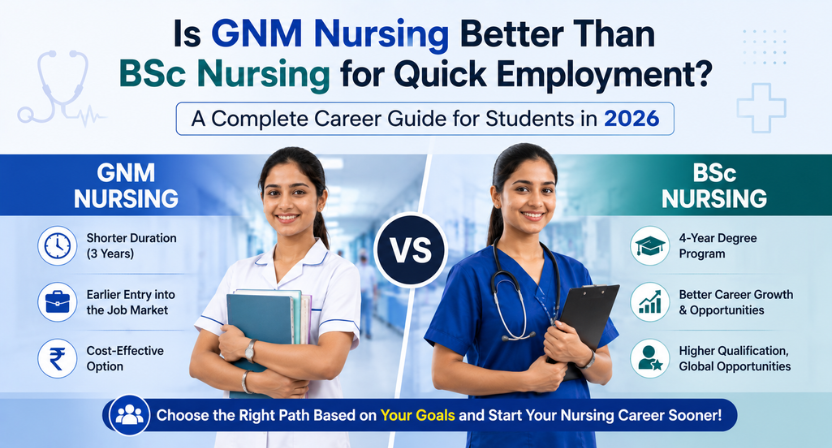
| Factor | GNM Nursing | BSc Nursing |
|---|---|---|
| Qualification | Diploma | Degree |
| Focus | Practical Nursing | Clinical + Academic Nursing |
| Employment Timeline | Earlier | Slightly Longer |
| Higher Education Opportunities | Limited Compared to BSc | Extensive |
| International Recognition | Available but varies | Generally broader |
| Leadership Opportunities | Possible with experience | More accessible |
| Career Growth Potential | Strong | Very Strong |
| Hospital Demand | High | High |
This is often the biggest concern for students and parents.
If the primary goal is to enter the workforce quickly, GNM Nursing may offer an advantage because students can complete their training and begin seeking employment sooner than degree-based pathways.
Many hospitals recruit GNM graduates for roles such as:
However, students should understand that “quick employment” and “long-term career growth” are not always the same thing.
A career decision should consider both immediate opportunities and future potential.
One of the biggest misconceptions among students is that hospitals only prefer BSc Nursing graduates and that GNM Nursing has become outdated. This belief often creates unnecessary confusion during the admission process.
In reality, hospitals continue hiring thousands of GNM nurses every year because nursing shortages remain a major challenge across healthcare systems. As patient admissions increase and hospitals expand their services, the demand for trained nursing professionals continues to grow.
Every hospital requires nurses to provide continuous patient care. While doctors visit patients during specific consultations and treatment rounds, nurses remain involved throughout the patient journey. They monitor patient conditions, administer medications, assist during procedures, coordinate with doctors, communicate with family members, and provide emotional support during recovery.
For example, a patient recovering from surgery may interact with nurses dozens of times during their hospital stay. Nurses help monitor vital signs, identify complications early, manage medications, support mobility, and ensure treatment plans are followed correctly.
GNM nurses are commonly employed in:
Medical and Surgical Wards
These departments require nurses to monitor patient recovery, administer treatments, and coordinate care with doctors and specialists.
Intensive Care Units (ICUs)
Many experienced GNM nurses build successful careers in critical care environments where patients require continuous monitoring and specialized nursing support.
Emergency Departments
Emergency care settings depend heavily on skilled nurses who can respond quickly during accidents, trauma cases, and medical emergencies.
Maternal and Child Healthcare Units
GNM training includes exposure to maternal healthcare, making graduates valuable members of maternity and paediatric care teams.
Home Healthcare Services
As healthcare increasingly moves beyond hospitals, home healthcare has become one of the fastest-growing employment sectors for nurses.
The key takeaway is that hospitals do not simply hire based on qualification titles. They hire professionals who can provide safe, compassionate, and effective patient care. Students who develop strong clinical skills, communication abilities, and practical confidence often become highly employable regardless of whether they begin with GNM or BSc Nursing.
While GNM may provide earlier workforce entry, BSc Nursing is often viewed as a long-term career investment.
This is because BSc Nursing graduates frequently have access to:
Students who wish to pursue:
often find BSc Nursing provides a stronger academic foundation.
GNM graduates can build successful careers in multiple healthcare settings.
Hospital Staff Nurse
Hospitals remain the largest employer of GNM graduates.
Responsibilities include:
ICU and Critical Care Nursing
Many GNM nurses eventually work in:
These roles require advanced clinical confidence and observation skills.
Community Healthcare
Community healthcare remains a major employment area.
Nurses support:
Home Healthcare
Home healthcare continues growing rapidly.
Many patients require:
This has created significant demand for qualified nursing professionals.
BSc Nursing graduates can pursue all of the opportunities available to GNM graduates while also accessing additional pathways.
These include:
This broader scope is one reason many students choose BSc Nursing despite the longer educational pathway.
Salary is one of the most important factors students and parents consider when choosing a nursing course. However, focusing only on starting salary can sometimes lead to unrealistic expectations.
In healthcare, long-term earning potential is often influenced more by experience, specialization, and professional development than by the initial qualification alone.
A newly qualified nurse generally begins their career by building practical experience in hospital settings. During the first few years, nurses develop essential competencies such as patient assessment, emergency response, medication management, and interdisciplinary collaboration.
As experience increases, opportunities also expand into:
Professionals who pursue advanced certifications or higher education often gain access to leadership positions and specialized healthcare roles that offer stronger earning potential.
Students should therefore view nursing not as a short-term job but as a long-term professional career where skills, expertise, and patient-care excellence directly influence career progression.
Yes.
Many students assume international opportunities are only available to BSc Nursing graduates.
In reality, international opportunities depend on:
Countries such as:
continue to require qualified nursing professionals.
Students interested in working abroad should research destination-specific regulations early in their careers.
One of the biggest misconceptions among students is that employers focus primarily on qualifications.
Modern hospitals increasingly prioritize:
Healthcare employers consistently report that practical competence often influences hiring decisions more than academic scores alone.
This is why clinical exposure during education is so important.
Healthcare is not a profession that can be mastered through textbooks alone.
Students must develop confidence through:
The quality of clinical exposure often has a greater impact on employability than the course name itself. A student trained in a strong clinical environment may perform significantly better than a student with limited practical exposure.
How to Decide Between GNM Nursing and BSc Nursing
Choose GNM Nursing if:
Choose BSc Nursing if:
Neither course is universally better.
The right choice depends on your personal goals. often achieve stronger long-term career growth.
At Little Flower Group of Institutions, nursing education focuses on preparing students for real healthcare environments.
Students receive:
The institution follows nursing education standards aligned with:
The goal is not only to help students complete a course but also to help them become confident healthcare professionals.
So, is GNM Nursing better than BSc Nursing for quick employment?
If your primary goal is to enter the healthcare workforce as early as possible, GNM Nursing may offer a faster pathway.
However, if your focus is broader career growth, advanced education, and long-term professional opportunities, BSc Nursing may provide additional advantages.
The most important factor is not simply choosing a course.
It is choosing a learning environment that provides strong clinical exposure, practical training, and real-world healthcare experience.
Both GNM Nursing and BSc Nursing continue to offer meaningful, stable, and respected healthcare careers in 2026 and beyond.
Both courses require dedication and practical learning. BSc Nursing generally includes broader academic content, while GNM focuses heavily on practical nursing skills.
GNM Nursing may allow students to enter the workforce earlier, making it attractive for students seeking quicker employment opportunities.
Yes. Various pathways are available for professional advancement and additional qualifications after GNM.
Yes. Hospitals continue to employ both qualifications based on organizational requirements and specific roles.
International opportunities depend on licensing requirements and destination-country regulations rather than only the qualification title.
The best choice depends on your career goals, financial situation, and long-term plans. Students should evaluate both short-term employment and future growth opportunities before deciding.