Key Takeaways
The challenges faced by BSc Nursing students are often very different from what students expect before joining the course. Many students focus on admissions, subjects, and career opportunities. However, nursing education involves much more than classroom learning.
A BSc Nursing course combines theory classes, practical training, hospital postings, assignments, and patient interaction. Students must balance academics and clinical responsibilities at the same time — often from the very first year.
Many students researching BSc Nursing admission in Bangalore focus on eligibility, fees, and college selection. However, understanding the realities of nursing education is equally important because it helps students prepare for the journey ahead.
The good news is that these experiences are normal. Almost every nursing student faces challenges at some stage. Knowing what to expect helps students prepare better and adapt faster.
The honest answer is yes — but it is manageable.
Students must learn scientific concepts, develop clinical skills, and apply knowledge in real healthcare settings. Unlike many degree programs, nursing requires patient interaction from an early stage. As a result, students often experience both academic and practical pressure simultaneously.
Most students adapt gradually. With regular study, clinical exposure, and proper guidance, the challenges faced by BSc Nursing students become more manageable with each passing year.
The first year is the hardest adjustment period for most students.
Many enter nursing college with little idea of how healthcare education works. Subjects like anatomy and physiology require deep understanding rather than simple memorization. Students reviewing BSc Nursing 1st year subjects are often surprised by the volume and depth of content.
On top of academics, first-year students face their first hospital posting. Speaking with patients, following clinical protocols, and adapting to a professional healthcare environment can feel overwhelming initially. Fear of making mistakes is one of the most commonly reported difficulties at this stage.
Developing effective study habits early makes a significant difference. School-level revision methods rarely work in nursing education. Students who build structured routines in the first year usually find later years far easier to manage.
By the second year, students are more familiar with the course. However, the challenges faced by BSc Nursing students shift rather than disappear.
Clinical responsibilities increase. Community health postings begin. Practical examinations become more detailed and are assessed formally. Students studying BSc Nursing 2nd year subjects must simultaneously attend classes, complete assignments, maintain clinical records, and participate in ward activities.
Time management becomes the defining skill at this stage. Students who struggle to organise their schedules often feel overwhelmed by competing demands.
The third year is a turning point. Students are expected to participate more actively in patient care, perform advanced clinical procedures, and demonstrate independent professional judgment.
Students studying BSc Nursing 3rd year subjects also encounter research work, case presentations, and nursing care plans. These tasks require critical thinking and self-directed learning — a significant shift from earlier years.
Many students also begin thinking about postgraduate education during the third year. This adds another layer of pressure alongside the other challenges faced by BSc Nursing students at this stage.
The final year brings a different set of challenges entirely.
Long clinical hours, shift duties, and continuous patient care during internship lead to physical and mental fatigue for many students. Balancing internship responsibilities with final examination preparation is one of the most demanding parts of the entire course.
Career anxiety also peaks during this period. Questions about job opportunities, salaries, higher education, and career direction create additional stress. Students exploring the scope of nursing in India often discover that opportunities extend beyond hospitals into education, research, and community health — but choosing a direction can still feel difficult without clear guidance.
Some male students face social misconceptions about nursing being a primarily female profession. These perceptions have little basis in modern healthcare, where competence and qualifications determine career outcomes. Students researching whether nursing is only for girls often find that male nurses are in strong demand across critical care, emergency departments, and international healthcare settings. Confidence typically grows through clinical experience and professional achievement.
Students from regional-language schools may initially struggle with English-medium textbooks and medical terminology. Those without strong science foundations may need extra time with biology and chemistry concepts. Both challenges are common and can be addressed through consistent reading, faculty support, and peer study groups.
Last-minute studying creates more stress than it solves. A weekly schedule that includes theory revision, practical preparation, assignment work, and personal time works far better than irregular long sessions.
Reading about procedures and patient care techniques before entering the ward reduces anxiety significantly. Students who understand what they will encounter beforehand participate more confidently during clinical sessions.
Many challenges faced by BSc Nursing students grow because students hesitate to ask for support. Speaking with faculty members, clinical instructors, or senior students when a concept feels unclear prevents small difficulties from becoming bigger problems.
Friends and classmates often face identical challenges. Sharing notes, discussing difficult concepts, and supporting each other reduces stress and improves motivation. Peer support is consistently one of the most valuable parts of nursing education.
Mistakes are part of clinical learning. Students who focus on steady improvement rather than flawless performance handle pressure more effectively and build stronger professional confidence over time.
Many students only discover these truths after struggling unnecessarily for months:
Knowing these things earlier would have saved many nursing students significant stress. If you are currently finding the course difficult, you are not alone — and you are not falling behind.
In many ways, yes.
The first year feels hardest because everything is unfamiliar. Students who once found anatomy overwhelming gradually become comfortable discussing complex healthcare concepts. Those who were nervous during their first ward posting learn to communicate with patients and perform procedures with confidence.
The challenges faced by BSc Nursing students do not disappear — they evolve. First-year students face adjustment. Second-year students manage balance. Third-year students handle increased responsibility. Final-year students navigate career decisions. With each stage, students become more capable and better prepared for professional practice.
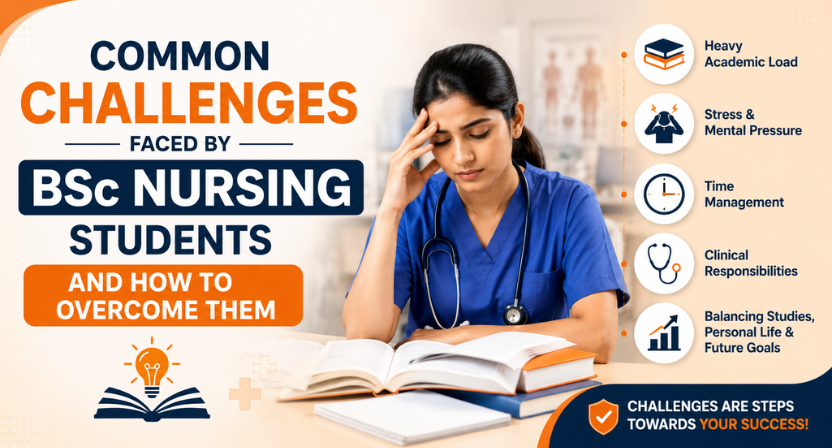
The challenges faced by BSc Nursing students are a normal part of healthcare education. Academic pressure, clinical responsibilities, time management, and emotional demands affect students across all four years.
Understanding these challenges before starting the course helps students prepare more effectively. More importantly, it is a reminder that struggling occasionally does not mean a student is unsuited for nursing.
Students comparing GNM vs BSc Nursing often choose BSc Nursing because it offers broader career pathways and stronger opportunities for higher education. Whichever path you choose, consistent effort, proper planning, and the right support system will help you navigate the journey successfully.
Academic workload, balancing theory and clinical training, examination pressure, time management, and adapting to hospital environments are among the most common challenges faced by BSc Nursing students.
Yes, but manageable. The course demands consistent effort across academics and clinical practice. Most students adapt successfully over time.
Balancing academic studies with clinical postings is consistently reported as the biggest challenge, particularly in the second and third years.
For most students, yes. Familiarity with medical terminology, clinical environments, and study methods makes subsequent years more manageable.
Creating study schedules, preparing before clinical postings, seeking faculty guidance early, building peer support networks, and focusing on consistent progress rather than perfection all help significantly.
Yes. Almost every nursing student experiences some form of academic, clinical, or personal challenge during the course. These experiences are a natural part of professional healthcare education.