Key Takeaways
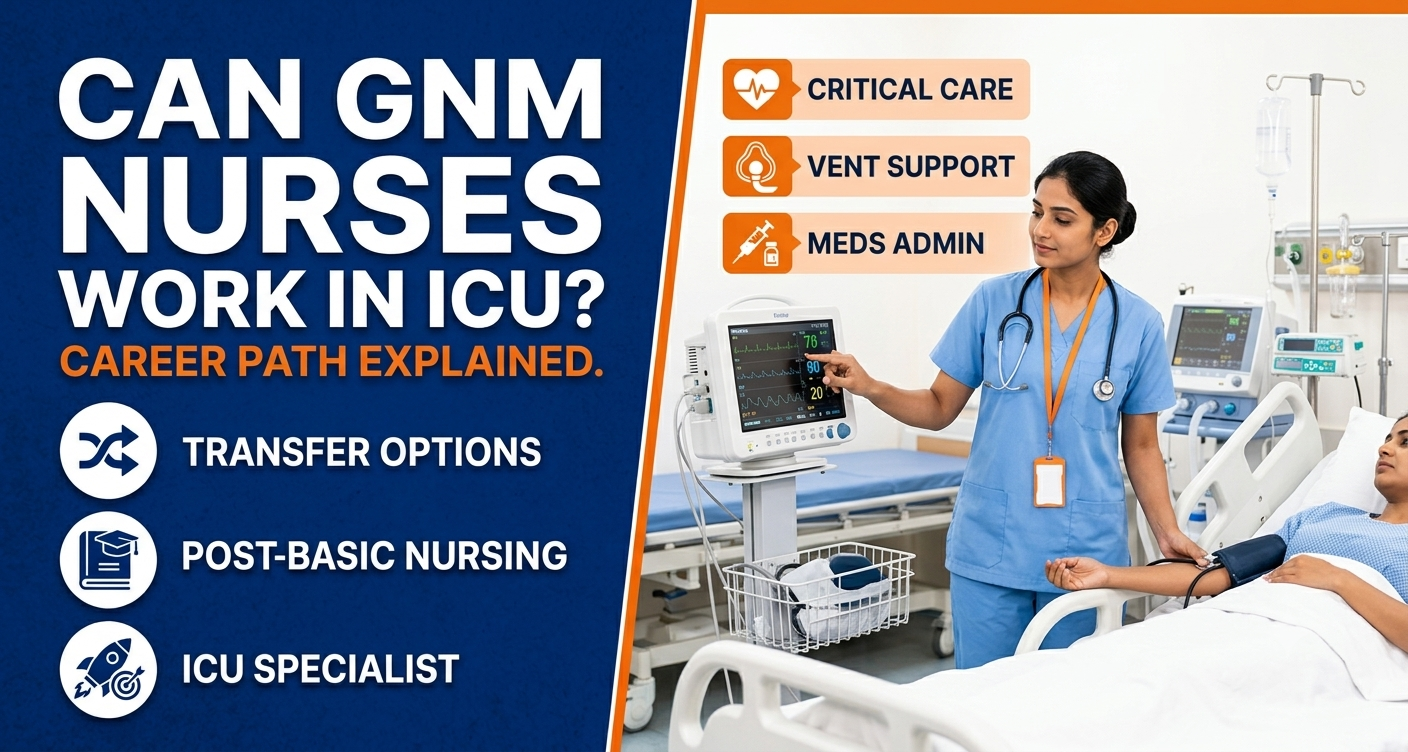
One of the most common questions asked by students planning a nursing career is “Can GNM nurses work in ICU?”
The answer is yes. General Nursing and Midwifery (GNM) graduates are eligible to work in Intensive Care Units (ICUs) in many hospitals, provided they meet the hospital’s recruitment criteria and demonstrate the clinical skills required for critical patient care.
For many nursing students, the ICU represents one of the most respected and challenging departments in a hospital. It is where critically ill patients receive constant monitoring, advanced treatment, and life-saving care. Working in such an environment requires not only technical knowledge but also confidence, quick decision-making, teamwork, and compassion.
Many students believe that only BSc Nursing graduates can work in ICUs. This is a common misconception. In reality, hospitals recruit both GNM and BSc Nursing graduates for ICU positions based on their qualifications, clinical competence, and training. While some hospitals may have specific eligibility requirements, GNM nurses continue to play an important role in critical care units across India.
If you are considering GNM Nursing and wondering whether an ICU career is possible, this guide will explain everything you need to know—from eligibility and responsibilities to career growth and specialization opportunities.
An Intensive Care Unit is a specialized department within a hospital that provides continuous care to patients with serious or life-threatening medical conditions.
Patients admitted to an ICU require close observation because their condition can change rapidly. Unlike general wards, ICUs are equipped with advanced monitoring systems and life-support equipment that help healthcare teams provide immediate medical intervention whenever necessary.
Patients may be admitted to an ICU for several reasons, including:
Because of the critical nature of patient care, ICUs function through teamwork. Doctors, nurses, respiratory therapists, physiotherapists, laboratory professionals, and other healthcare specialists work together to ensure the best possible outcomes for patients.
Among these professionals, ICU nurses spend the most time with patients, continuously monitoring their condition and providing essential nursing care.
Yes, GNM nurses can work in ICUs.
After completing the GNM Nursing program, registering with the appropriate Nursing Council, and meeting hospital recruitment requirements, GNM graduates can apply for ICU nursing positions.
Many private hospitals, multispecialty hospitals, and healthcare institutions recruit GNM nurses for:
Some hospitals provide newly appointed nurses with ICU induction programs where they learn department-specific procedures before independently caring for critically ill patients.
Others may initially post nurses to general wards before transferring them to critical care units after gaining clinical experience.
Therefore, while the pathway may vary between hospitals, working in an ICU is certainly a realistic career option for GNM graduates.
India’s healthcare system continues to expand rapidly, leading to increased demand for qualified nursing professionals across all departments, including intensive care.
Hospitals require a large number of trained nurses because ICU patients require constant monitoring, frequent assessments, medication administration, and immediate responses to emergencies.
GNM graduates receive extensive practical training during their course, including:
These foundational skills make GNM graduates suitable candidates for ICU nursing roles when combined with additional hospital-based training.
Modern hospitals also recognize that practical competence, willingness to learn, and professional attitude are just as important as academic qualifications.
Working in an ICU involves much more than checking patients or administering medicines.
ICU nurses continuously monitor critically ill patients whose conditions may change within minutes. Every observation made by an ICU nurse can influence treatment decisions and patient outcomes.
Some of the major responsibilities include:
Continuous Patient Monitoring
ICU nurses observe:
Any unusual change must be reported immediately to the treating physician.
Medication Administration
Critically ill patients often receive multiple medications through intravenous lines.
ICU nurses carefully administer:
Because patient conditions are highly sensitive, medication accuracy is extremely important.
Managing Medical Equipment
Modern ICUs use advanced medical equipment to support patient care.
ICU nurses learn to work with:
Although doctors make treatment decisions, nurses ensure these systems function properly and monitor patients using them.
Infection Prevention
Critically ill patients have a higher risk of developing infections.
ICU nurses strictly follow infection-control protocols such as:
Preventing hospital-acquired infections is one of the most important responsibilities of every ICU nurse.
Supporting Patients and Families
ICU patients and their families often experience significant emotional stress.
Nurses provide reassurance, explain basic procedures, support families during difficult situations, and communicate updates in coordination with doctors.
Strong communication and empathy are therefore essential qualities for ICU nurses.
Working in critical care requires more than completing a nursing course.
Successful ICU nurses develop a combination of technical knowledge and professional skills that help them perform confidently under pressure.
Some of the most important skills include:
Clinical Observation Skills
Recognizing early changes in a patient’s condition can prevent medical emergencies.
ICU nurses develop strong assessment skills by learning to identify subtle changes in vital signs, breathing patterns, neurological responses, and patient behaviour.
Critical Thinking
Every patient in an ICU is different.
Nurses must evaluate clinical information quickly, prioritize patient needs, and communicate effectively with doctors to ensure timely treatment.
Attention to Detail
Small mistakes can have significant consequences in critical care.
Whether administering medication, monitoring equipment, or documenting observations, ICU nurses must maintain a high level of accuracy at all times.
Teamwork
Intensive care is built on multidisciplinary collaboration.
Nurses work closely with doctors, physiotherapists, respiratory therapists, laboratory professionals, and other healthcare staff to provide comprehensive patient care.
Effective teamwork improves patient safety and treatment outcomes.
One of the biggest concerns among GNM students is whether completing the GNM course alone is enough to work in an Intensive Care Unit.
The answer depends on the hospital’s recruitment policies and the complexity of the ICU.
Most hospitals understand that newly graduated nurses need time to adapt to the fast-paced environment of critical care. Therefore, many healthcare institutions conduct structured orientation and induction programs before assigning nurses independent responsibilities.
During these training programs, nurses become familiar with:
Some hospitals also assign experienced ICU nurses as mentors who supervise newly recruited nurses during their initial months. This mentorship helps new nurses build confidence while learning to manage critically ill patients safely.
As nurses gain experience, they gradually handle more complex clinical responsibilities under the guidance of senior nursing staff.
Can GNM Nurses Specialize in Critical Care Nursing?
Yes.
Many GNM nurses choose to enhance their careers by pursuing additional certifications or specialized training in Critical Care Nursing.
Although specialization is not mandatory for every ICU position, it provides several advantages.
Specialized training helps nurses develop advanced knowledge in areas such as:
Specialization also demonstrates a commitment to professional development, which many hospitals value during recruitment and promotions.
For students who wish to spend their careers in critical care, continuous learning becomes an important part of professional growth.
An ICU career offers excellent opportunities for long-term professional development.
Many nurses begin as junior staff nurses and gradually progress into more senior roles as they gain experience, clinical expertise, and leadership skills.
A typical career pathway may look like this:
Staff Nurse
Fresh GNM graduates often begin as Staff Nurses, where they provide direct patient care under the supervision of senior nurses and doctors.
During this stage, they develop confidence in patient monitoring, medication administration, infection control, and documentation.
ICU Nurse
After gaining experience and completing department-specific training, nurses may be assigned full-time responsibilities in Medical, Surgical, Cardiac, Neonatal, or Pediatric ICUs.
Their role expands to include managing critically ill patients, monitoring sophisticated medical equipment, and responding quickly to emergencies.
Senior ICU Nurse
With several years of experience, nurses often become senior members of the ICU team.
They guide junior nurses, coordinate patient care, assist during emergencies, and contribute to maintaining quality standards within the department.
Nurse Educator or Clinical Instructor
Experienced ICU nurses who enjoy teaching may transition into educational roles where they train nursing students and newly recruited staff.
Their practical knowledge helps bridge the gap between classroom learning and real clinical practice.
Nursing Supervisor or Nurse Manager
Leadership positions involve managing nursing teams, ensuring patient safety, coordinating departmental activities, and maintaining clinical standards.
Strong communication, organizational abilities, and professional experience become essential at this stage.
Many students planning a nursing career also wonder whether ICU experience can create international opportunities.
The answer is yes.
Several countries continue to experience shortages of qualified nursing professionals, particularly in critical care departments.
Countries such as:
often recruit experienced ICU nurses after they meet the required licensing and registration requirements.
Although every country has its own eligibility criteria, ICU experience is generally considered valuable because critical care nursing requires advanced clinical competence and decision-making skills.
Students interested in international careers should research licensing examinations, language requirements, and registration processes early in their professional journey.
While technical knowledge is essential, successful ICU nurses also develop important professional qualities that help them perform effectively in high-pressure environments.
Emotional Resilience
Working with critically ill patients can be emotionally challenging.
ICU nurses must remain calm, focused, and compassionate while providing the highest level of patient care, even during stressful situations.
Learning to manage emotions while maintaining professionalism is an important part of critical care nursing.
Excellent Communication
ICU nurses interact continuously with doctors, patients, family members, physiotherapists, laboratory professionals, and other healthcare staff.
Clear communication improves teamwork, reduces misunderstandings, and ensures that patients receive timely treatment.
Adaptability
No two days in an ICU are the same.
Patient conditions may change unexpectedly, requiring nurses to respond quickly while following established clinical protocols.
Adaptability allows nurses to remain effective in rapidly changing healthcare environments.
Commitment to Lifelong Learning
Healthcare continues to evolve with new treatment methods, advanced equipment, and updated clinical guidelines.
Successful ICU nurses regularly participate in continuing education programs, workshops, and professional development activities to keep their knowledge current.
Continuous learning not only improves patient care but also opens doors to advanced career opportunities.
Students often focus heavily on classroom subjects when choosing a nursing college. However, practical exposure plays an even greater role in preparing nurses for ICU careers.
Clinical postings allow students to:
Hospitals prefer graduates who are comfortable working in patient-care environments from the beginning of their careers. Therefore, choosing an institution that provides quality clinical exposure can significantly improve future employability.
Why Students Choose Little Flower Group of Institutions for Nursing
At Little Flower Group of Institutions, nursing education is designed to prepare students for the realities of modern healthcare rather than examinations alone.
The GNM Nursing program combines academic learning with practical clinical exposure so that students develop both technical competence and professional confidence.
Students benefit from:
The nursing program follows the standards prescribed by the Indian Nursing Council (INC), the Karnataka Nursing Council (KNC), and the academic framework of the Rajiv Gandhi University of Health Sciences (RGUHS).
The institution focuses on preparing compassionate, confident, and industry-ready nursing professionals who can contribute effectively to hospitals, critical care units, community healthcare, and other clinical settings.
So, can GNM nurses work in ICU?
The answer is yes. GNM graduates can build successful careers in Intensive Care Units by combining their nursing education with practical clinical experience, hospital-based training, and a commitment to continuous learning.
ICU nursing is one of the most respected areas of healthcare because it requires advanced clinical skills, quick decision-making, teamwork, and compassion. Although the work is demanding, it offers excellent opportunities for professional growth, specialization, and long-term career stability.
Students who are passionate about patient care and willing to continuously improve their clinical knowledge can build rewarding careers in critical care nursing. Choosing a nursing institution that emphasizes practical training, clinical exposure, and professional development is an important first step toward achieving that goal.
Yes. GNM nurses can work in Intensive Care Units after completing their nursing education, obtaining the required registration, and meeting the recruitment criteria of the hospital.
Many hospitals provide ICU orientation or induction programs for newly recruited nurses. Additional certifications in Critical Care Nursing can further improve knowledge and career opportunities.
ICU nurses require strong clinical observation, communication, teamwork, critical thinking, infection control knowledge, medication management, and the ability to remain calm during emergencies.
Yes. ICU nursing offers excellent learning opportunities, professional growth, specialization options, and strong demand in hospitals across India and internationally.
Yes. By gaining clinical experience and pursuing specialized training or certifications in Critical Care Nursing, GNM nurses can develop expertise in intensive care.
Yes. Many countries value ICU nursing experience. However, nurses must meet the licensing, registration, and language requirements of the country where they wish to work.