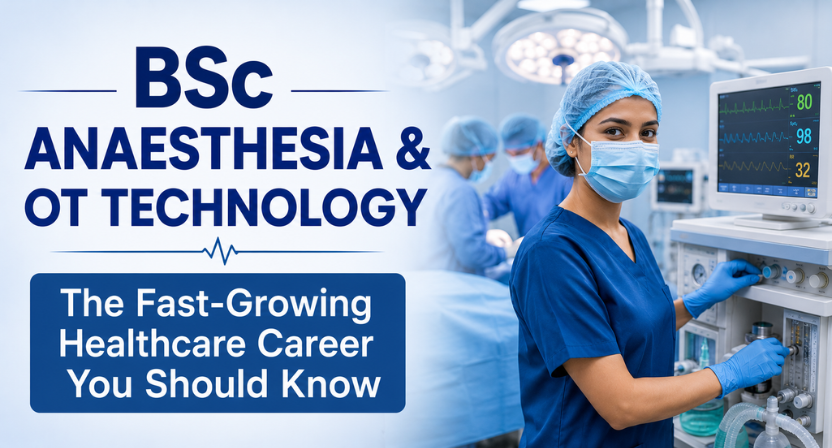
As India’s healthcare system expands with more multispecialty hospitals, advanced ICUs, emergency units, and high-tech operation theatres, the demand for trained Anaesthesia & Operation Theatre Technologists (AOTT) is rising faster than ever. Surgical procedures in India have seen a massive year-on-year increase, creating a critical need for professionals who can assist anaesthesiologists, manage OT workflows, and support life-saving procedures inside the operation theatre.
For students looking for a medical career without NEET, BSc Anaesthesia & Operation Theatre Technology has become one of the most promising pathways. The course offers:
At Little Flower Institutions, Bangalore, students receive RGUHS-affiliated training, practical exposure in leading hospitals, and guided clinical postings that transform them into confident, skilled professionals ready to support complex surgical and anaesthesia procedures from day one.
BSc Anaesthesia & Operation Theatre Technology (AOTT) is a 4-year professional Allied Health Science program that trains students to work alongside anaesthesiologists and surgeons during medical and surgical procedures. Unlike nursing or general paramedical courses, AOTT focuses specifically on the pre-operative, intra-operative, and post-operative management of patients inside the Operation Theatre.
Role of an Anaesthesia Technologist
Anaesthesia technologists assist anaesthesiologists during surgeries by:
They play a crucial role in ensuring patient safety throughout the surgical process.
OT technologists ensure smooth and sterile functioning of the operation theatre by:
They are the backbone of every surgery—from general procedures to advanced cardiac, neuro, ortho, and laparoscopic operations.
| Course | Focus Area | Nature of Work |
| AOTT | Anaesthesia support + OT procedures | Tech-driven, surgical assistance, device handling |
| Nursing | Patient care, ward management | Patient monitoring, medication, bedside care |
| Paramedical | Diagnostics/emergency care | Lab tests, imaging, emergency response |
AOTT is ideal for students who want a medical + technical career, specifically in surgical and critical care environments.
Professionals are employed in:
Daycare surgery units & high-dependency units.
BSc AOTT is one of the most rewarding Allied Health programs for students who want to build a medical career inside operation theatres, ICUs, and critical care units—without NEET. It offers strong employability, global career pathways, and long-term professional stability.
1. High Employability Across Hospitals
With the rapid growth of surgical departments, multispecialty hospitals now require trained anaesthesia and OT technologists for every procedure.
AOTT graduates are hired in:
2. Work Directly Inside Operation Theatres
If you want to be part of real surgical procedures, this course puts you at the centre of action.
You work alongside:
3. Opportunity to Specialise in High-Demand Areas
AOTT graduates can advance into specialized fields with better salaries:
4. Global Demand in the Gulf, UK, Germany & Australia
Countries facing healthcare workforce shortages actively recruit:
5. Faster Entry Into the Healthcare System
Unlike long MBBS or nursing routes, AOTT offers:
6. Job Security + Recession-Proof Career
Surgeries cannot be automated or outsourced—and hospitals always require skilled technologists.
This makes AOTT a stable, recession-proof medical career with predictable growth.
Choosing BSc Anaesthesia & Operation Theatre Technology requires understanding the core admission requirements. Here’s a clear, student-friendly breakdown:
Duration
3 years academic learning + clinical internship
The internship is done in tied-up multispecialty hospitals, giving students real OT and ICU exposure from day one.
Eligibility (Little Flower Institutions
Age Limit
Little Flower follows a transparent, student-friendly admission process with full academic and career guidance.
The BSc AOTT syllabus is designed to train students in anaesthesia techniques, surgical support, OT workflow, and ICU-level patient monitoring. Here is the year-wise breakdown:
Year 1 – Foundation in Medical Sciences
Clinical Exposure: Basic OT observation, sterilization, and infection control.
Year 2 – Core Anaesthesia & OT Training
Clinical Postings:
General OT, pre-operative care, recovery room duties.
Year 3 – Advanced Anaesthesia & Critical Care
Clinical Postings:
ICU, emergency department, specialized OTs (cardiac, neuro, ortho).
Students rotate across:
This internship ensures job-ready skills in real surgical environments – a major advantage at Little Flower Institutions due to strong hospital tie-ups.
For a career inside operation theatres, hands-on clinical exposure is the single most important element — and it is where BSc Anaesthesia & OT Technology truly stands apart from other healthcare programs.
At Little Flower Institutions, practical training begins early and continues throughout the course, thanks to strong hospital tie-ups with:
Rangadore Memorial Hospital, Manasa Hospital, Unity Lifeline Hospital, CHC Kengeri, and NIMHANS (one of India’s top tertiary centers).
Students undergo real-time training in the following critical areas:
Mention Little Flower’s hospital tie-ups (HUGE SEO + trust signal)
A BSc in Anaesthesia & Operation Theatre Technology opens the door to some of the most essential and high-demand roles inside hospitals, especially as India witnesses rapid growth in surgical, critical care, and trauma services.
Graduates from Little Flower Institutions — with strong OT and ICU exposure — are preferred by multispecialty hospitals for their hands-on readiness.
With India witnessing a steep rise in surgeries and ICU admissions, AOTT graduates enjoy excellent job stability, growing salaries, and global opportunities.
A career in Anaesthesia & OT Technology offers strong starting salaries and rapid salary growth because hospitals depend heavily on skilled technologists inside operation theatres and ICUs. Salary increases significantly with specialization, shift duties, and experience inside high-volume surgical departments.
Salary Breakdown (2026–2027 Outlook)
International Salary Scale
Countries facing acute healthcare workforce shortages offer significantly higher pay:
With global shortages in OT & anaesthesia departments, AOTT graduates enjoy excellent mobility abroad.
The demand for AOTT graduates is predicted to grow consistently till 2035, driven by India’s expanding healthcare system and technological advancements.
Key Trends Driving Massive Demand
AOTT is one of the most future-proof careers in healthcare, with stable growth and global opportunities.
Choosing between Allied Health vs Paramedical depends on your academic goals and the level of responsibility you aspire to hold.
Here’s a quick comparison to help students decide the best path:
| Feature | BSc AOTT | Diploma OTT | Nursing |
| Duration | 4 years (3 + 1 internship) | 2 – 3 years | 4 years |
| Job Role | OT + Anaesthesia | OT only | Patient care & ward management |
| Career Growth | High (dual specialization) | Moderate | High |
| Salary | Higher | Moderate | Varied |
| Global Mobility | Strong | Moderate | Strong |
| Work Domains | OTs, ICUs, Emergency, Pain Clinics | OTs, Surgical Units | Hospitals, Clinics, Community Health |
Best Choice for Fast Placement + High Demand: BSc AOTT
BSc Anaesthesia & Operation Theatre Technology is one of India’s most future-proof medical careers — offering strong job security, high demand across hospitals, and stable career growth in both India and abroad. With continuous expansion in surgeries, ICUs, emergency departments, and advanced OT technologies, skilled anaesthesia and OT technologists have become an essential part of every modern hospital.
At Little Flower Institutions, students gain a clear advantage through RGUHS-affiliated academics, advanced labs, full-scale OT setups, and direct clinical exposure in leading hospitals. The combination of expert faculty, real-time training, and strong placement support ensures every student graduates confident, competent, and industry-ready.