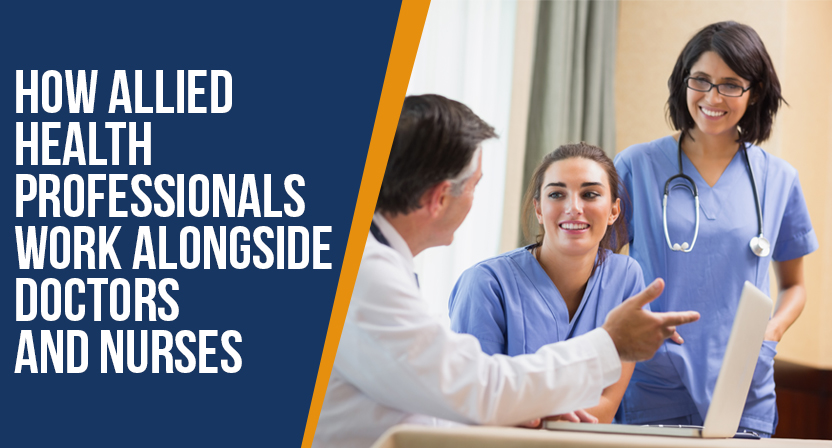
Allied health professionals work both inside and outside hospitals, supporting the wider healthcare ecosystem.
Modern healthcare is built on teamwork. The allied health professionals role in healthcare goes far beyond “supporting staff” labels. Allied health professionals work alongside doctors and nurses to ensure that diagnosis, treatment, and recovery happen smoothly and safely across departments.
Doctors focus on diagnosis and medical decision-making. Nurses manage continuous patient care and monitoring. The allied health professionals role in healthcare is to bridge critical gaps by providing:
Together, these roles form a coordinated healthcare system rather than separate functions working in silos.
At a system level, the allied health professionals role in healthcare is to provide specialised services that support medical and nursing care without replacing either role. Allied health professionals operate within clearly defined clinical frameworks and protocols.
Their contribution typically includes:
Because of this structure, doctors receive accurate inputs for decision-making, and nurses deliver care based on reliable assessments. This positioning makes the allied health professionals role in healthcare an integral part of healthcare delivery, not an optional layer.
Allied health professionals are trained healthcare practitioners who are neither doctors nor nurses but are directly involved in patient care. Common examples include:
What connects these professions is not the course name, but their function. The allied health professionals role in healthcare focuses on specialised clinical functions, teamwork, and coordination within healthcare systems. Their education is structured around hospital and clinical environments, as seen in programmes offered by institutions such as the Little Flower Institute of Allied Health Sciences
Doctors rely on allied health professionals for precise and timely clinical inputs. These inputs form the foundation for many medical decisions.
For example:
The allied health professionals role in healthcare follows a clear boundary. Allied health professionals do not diagnose conditions or prescribe treatment. Instead, they:
Doctors interpret this information and make final medical decisions. This structured hand-off maintains accuracy and accountability.
Collaboration between allied health professionals and nurses happens continuously throughout a patient’s care journey.
In practice:
For instance, a nurse may observe a patient’s mobility challenges, while a physiotherapist evaluates movement patterns and recommends exercises. The nurse then integrates this input into daily care routines. This coordination supports patient continuity and reflects the allied health professionals role in healthcare within team-based care. This collaboration is reinforced through structured nursing education pathways such as BSc Nursing programmes
The role of allied health professionals in hospitals spans multiple departments and functions, including:
Hospitals depend on these department-wise interactions to function efficiently. Clear role definitions reduce overlap, prevent errors, and ensure smooth patient movement across departments. This highlights the allied health professionals role in healthcare at an institutional level.
Healthcare systems manage patients with complex and overlapping needs. As a result, collaboration between allied health professionals, doctors, and nurses becomes essential rather than optional.
Effective collaboration ensures:
When collaboration works well, patient care moves smoothly from diagnosis to discharge without gaps in responsibility. This outcome-driven approach reinforces the allied health professionals role in healthcare within modern systems.
A common misconception is that allied health professionals play only secondary roles. In reality, their assessments and technical expertise directly influence:
Another misconception is confusion between allied health and paramedical roles. While both support healthcare delivery, their scopes, training, and responsibilities differ. Understanding the difference between allied health and paramedical professions helps clarify how healthcare teams are structured.
Although hospitals are a primary workplace, the allied health professionals role in healthcare extends beyond hospital settings. These professionals also work in:
In each environment, they continue to collaborate with doctors and nurses through referrals, shared reports, and follow-up care..
Allied health professionals strengthen healthcare teams by adding depth, precision, and specialised expertise. Their work allows:
Healthcare institutions that integrate allied health and nursing education, such as Little Flower Institutions, help prepare professionals for collaborative healthcare environments from the academic stage itself
They provide specialized diagnostic, technical, and therapeutic services that support doctors and nurses in patient care.
They collaborate through shared protocols, interdisciplinary communication, and coordinated workflows across departments.
They supply clinical data, assessments, and technical expertise that inform medical decision-making.
Nurses coordinate daily care while allied health professionals deliver specialized interventions within care plans.
Nursing focuses on continuous patient care, while allied health roles provide specialized diagnostic and therapeutic services.
Collaboration improves efficiency, patient safety, and continuity of care.
Key skills include technical competence, communication, teamwork, and adherence to clinical protocols.
No. Allied health professionals are trained specialists who work alongside doctors and nurses within defined scopes of practice.
The allied health professionals role in healthcare is essential to how modern healthcare systems function. By working alongside doctors and nurses through structured collaboration, allied health professionals ensure that care remains accurate, coordinated, and patient-centred.
Rather than operating on the margins, the allied health professionals role in healthcare forms a core pillar of healthcare delivery across hospitals and community settings alike.