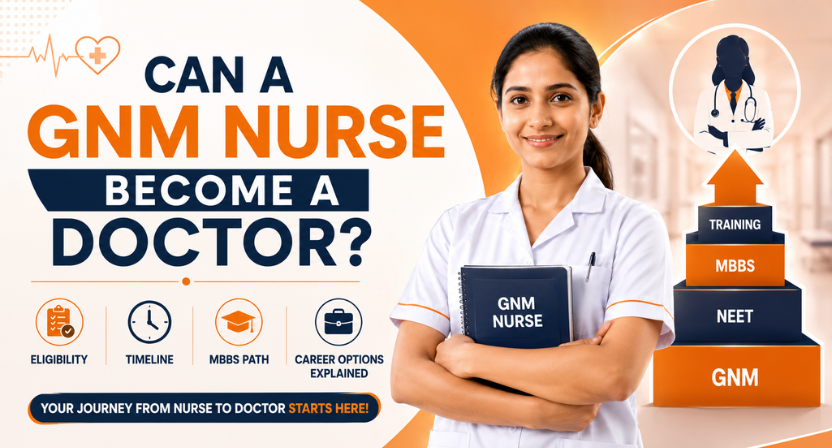
Can a GNM nurse become a doctor? Yes. However, the journey is longer than most students expect.
Many students start a GNM nursing career because it offers early entry into healthcare. After gaining clinical experience, some nurses decide they want to diagnose illnesses and prescribe treatment. This is understandable. However, nursing and medicine are separate professions. So a GNM nurse who wants to become a doctor must follow the same MBBS admission process as any other medical aspirant.
Knowing the timeline, costs, and alternative options will help students decide if this is the right path for them.
General Nursing and Midwifery (GNM) is a diploma nursing program. It prepares students for patient care, maternity services, community health, and hospital nursing roles.
Many students asking can a GNM nurse become a doctor are surprised to learn that GNM and MBBS are completely separate pathways. Both lead to healthcare careers but differ entirely in scope, duration, and clinical authority.
GNM graduates work in hospitals, clinics, nursing homes, and community health programs. The course is practical and hands-on.
Note: The Indian Nursing Council (INC) phased out GNM after the 2020–21 batch. However, existing GNM qualifications remain fully valid for employment, nursing registration, and higher education. GNM graduates can continue pursuing nursing careers and advanced studies without any issue.
So can a GNM nurse become a doctor after completing nursing? Yes, but not through a direct upgrade.
One common misconception is that GNM converts directly into MBBS. In reality, no such bridge program exists. GNM provides healthcare experience, but it does not reduce MBBS duration or give direct medical college admission.
As a result, any GNM nurse who wants to become a doctor must begin the medical admission process from the start – just like any other MBBS aspirant.
Yes, in most cases. NEET is the primary entrance exam for MBBS admission in India.
A nursing qualification does not replace NEET. Therefore, clearing NEET is one of the most important steps for any GNM nurse planning to become a doctor.
Moreover, a strong NEET score improves the chances of getting into a government medical college. This can reduce the overall cost of medical education significantly.
Many working nurses worry they may be too old to pursue medicine. The good news is that there is currently no upper age limit for NEET.
This means a GNM nurse can prepare for NEET even after several years of work experience. As a result, the doctor pathway remains open at any stage of a nursing career.
Always check the latest admission guidelines before applying, since regulations can change
Students who want to know how long it takes for a GNM nurse to become a doctor should plan for roughly a decade. Here is a realistic breakdown:
| Stage | Approximate Duration |
|---|---|
| GNM Nursing | 3 Years |
| Internship | 6 Months |
| NEET Preparation | 1–2 Years |
| MBBS Degree | 5.5 Years |
| Total Journey | Around 10–11 Years |
So a student who starts GNM today may spend roughly a decade before becoming a practicing doctor. This is a major commitment. Therefore, it is important to think carefully about long-term goals before choosing this path.
1. Complete GNM Nursing
Start by finishing GNM and obtaining your nursing qualification. Clinical training during this period builds strong patient-care skills and healthcare knowledge.
Check the MBBS eligibility criteria and confirm you qualify. Requirements vary by state and institution, so always review the latest guidelines.
Prepare for and clear NEET. Since medical admissions are highly competitive, strong preparation is essential for a good score.
After clearing NEET, participate in counseling to get a medical seat. Government colleges cost less than private institutions, so a higher score gives more affordable options.
Finish the full MBBS program and the one-year mandatory internship. Only after this can a candidate become a licensed doctor.
Cost matters just as much as time. Students should plan for:
Government colleges cost far less than private ones. Therefore, a strong NEET score is not just about admission — it directly affects how much the journey costs.ing provides a stronger academic foundation.
Many students asking can a GNM nurse become a doctor also want to know if international routes are easier. The short answer is no – the process abroad is equally structured and requires full medical education.
A GNM qualification may help graduates work as nurses abroad after meeting local licensing requirements. Becoming a doctor, though, is a completely separate process.
Candidates need a bachelor’s degree, medical school admission, and completion of a Doctor of Medicine (MD) program. Licensing exams and residency training are also compulsory before independent practice is allowed.
GNM nurses can work in the UK after meeting Nursing and Midwifery Council (NMC) requirements. However, becoming a doctor requires admission to a UK medical school and completion of the full training pathway. Some universities offer graduate-entry medicine programs for eligible candidates.
Australia offers graduate-entry MD programs open to applicants from various academic backgrounds. However, a GNM diploma alone is generally not recognized by Australia’s nursing accreditation body (ANMAC).
For this reason, completing Post Basic BSc Nursing is a necessary first step for most Indian GNM graduates before pursuing any medical or nursing registration pathway in Australia.
Canadian medical school admissions are highly competitive. Nursing experience may strengthen an application, but it does not replace the full medical education requirement.
GNM nurses can find employment in the UAE after obtaining the required professional license. However, becoming a doctor requires a recognized medical degree, internship completion, and compliance with local licensing regulations.
A GNM qualification opens doors to nursing careers abroad. However, becoming a doctor in any country still requires completing a full medical education pathway. So always review the specific requirements of your target country before making long-term decisions.
Before deciding whether a GNM nurse should become a doctor, it helps to ask a more specific question: is medicine actually your goal?
MBBS is the right choice if:
Advanced nursing may be the better choice if:
Many GNM nurses who want career growth choose Post Basic BSc Nursing followed by MSc Nursing. This builds on existing qualifications rather than replacing them. Both paths lead to strong healthcare careers. Ultimately, the right one depends on what you truly want from your career.
A GNM nurse can become a doctor — but that is not the only route to a senior healthcare career. Several other pathways offer strong growth while building on your existing qualification.
Post Basic BSc Nursing after GNM builds directly on nursing education. It opens advanced clinical roles and improves eligibility for international opportunities and postgraduate programs.
MSc Nursing after GNM and Post Basic BSc Nursing leads to specialist, academic, and leadership roles. Graduates move into teaching, hospital administration, clinical specialization, and research.
High-demand areas include Critical Care Nursing, Emergency Nursing, Oncology Nursing, Pediatric Nursing, and Operation Theatre Nursing. These specializations offer strong career progression both in India and abroad.
Experienced nurses can move into hospital management, quality assurance, and nursing education. These roles offer leadership growth without requiring a return to full-time study.
| Pathway | Additional Study Time | Typical Outcome |
|---|---|---|
| Post Basic BSc Nursing | 2 Years | Senior Clinical Nursing Roles |
| MSc Nursing | 2 Years | Specialist, Academic and Leadership Roles |
| Nursing Specializations | 1–2 Years | ICU, OT, Emergency and Critical Care Nursing |
| MBBS | 5.5 Years After Admission | Medical Doctor — Independent Practice |
MBBS is the only route to independent medical practice. Advanced nursing pathways deliver strong career growth in less time. So the best choice depends entirely on your goals.
Can a GNM nurse become a doctor? Yes — by qualifying NEET, securing MBBS admission, and completing the full five-and-a-half-year program including internship.
The total journey takes around 10–11 years. It requires financial investment, strong NEET preparation, and long-term commitment. For nurses whose core ambition is independent medical practice, MBBS is the right path.
For those focused on clinical growth, specialization, or leadership, advanced nursing education offers a faster and equally rewarding route. In the end, the best decision is the one that genuinely matches your career goals.
Yes. A GNM nurse can become a doctor by qualifying NEET, securing MBBS admission, and completing the full medical education pathway.
Yes. GNM graduates can pursue MBBS if they meet eligibility requirements and clear NEET.
Yes, in most cases. NEET is the primary entrance exam for MBBS admission across India.
Around 10–11 years in total — including GNM, internship, NEET preparation, MBBS, and the mandatory MBBS internship.
Yes. However, a GNM qualification does not automatically qualify someone for medical practice abroad. Candidates must meet the specific admission and licensing requirements of their chosen country.
No. There is currently no upper age limit for NEET. A GNM nurse can appear for NEET at any age, provided they meet the other eligibility criteria.
It is realistic but demanding. A GNM nurse can become a doctor in India, but the process requires clearing NEET, completing 5.5 years of MBBS, and a total commitment of around 10–11 years.